Damla Forumu

Certified production · batch tested · third-party audited

Clinically studied · Cold-pressed · Unrefined

Your hair isn't dying. It's being starved by DHT.

Pumpkin Seed Oil works at the follicle root — blocking the hormone that shrinks it. A few drops a day. No scalp routine, no dependency, no rebound shedding.

Free UK delivery · 90-day results guarantee

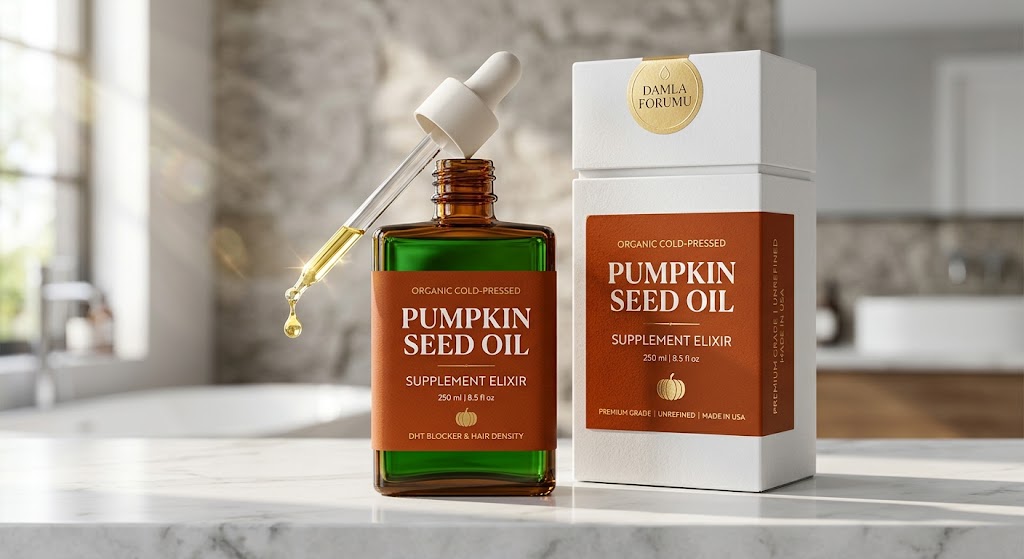
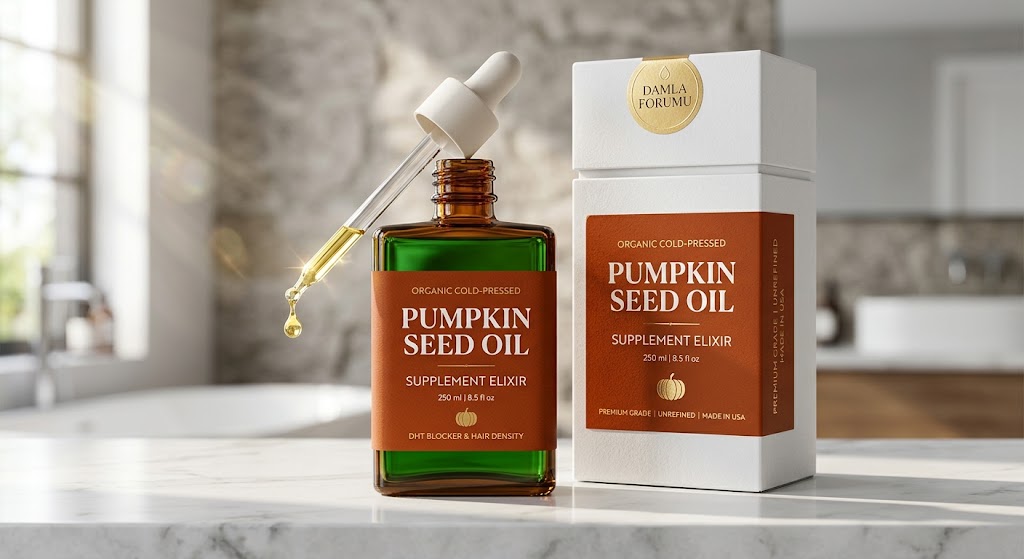
Cold-pressed pumpkin seed oil supplement elixir bottle and box

Delta-7 sterols

5-alpha-reductase · DHT

40%
average increase in hair count at 24 weeks
1×
dose of drops daily — that's the entire routine
0
reported scalp irritation or dependency
8k+
UK customers on the protocol

One seed. Five systems.

Every problem below is downstream of the same hormone.

01 / Hair density

Widening part, thinning crown, hair in the shower drain.

Thicker strands start under the skin, not on top of it.

Delta-7 sterols in cold-pressed pumpkin seed oil inhibit 5-alpha-reductase, the enzyme that converts testosterone into DHT. Less DHT at the follicle means the growth phase stops being cut short — strands come back thicker, darker and longer-lived.

  • Supports fuller, thicker regrowth at the crown and part line
  • Helps reduce daily shedding within the first 8–12 weeks
  • Feeds the follicle with zinc, omega-6 and vitamin E
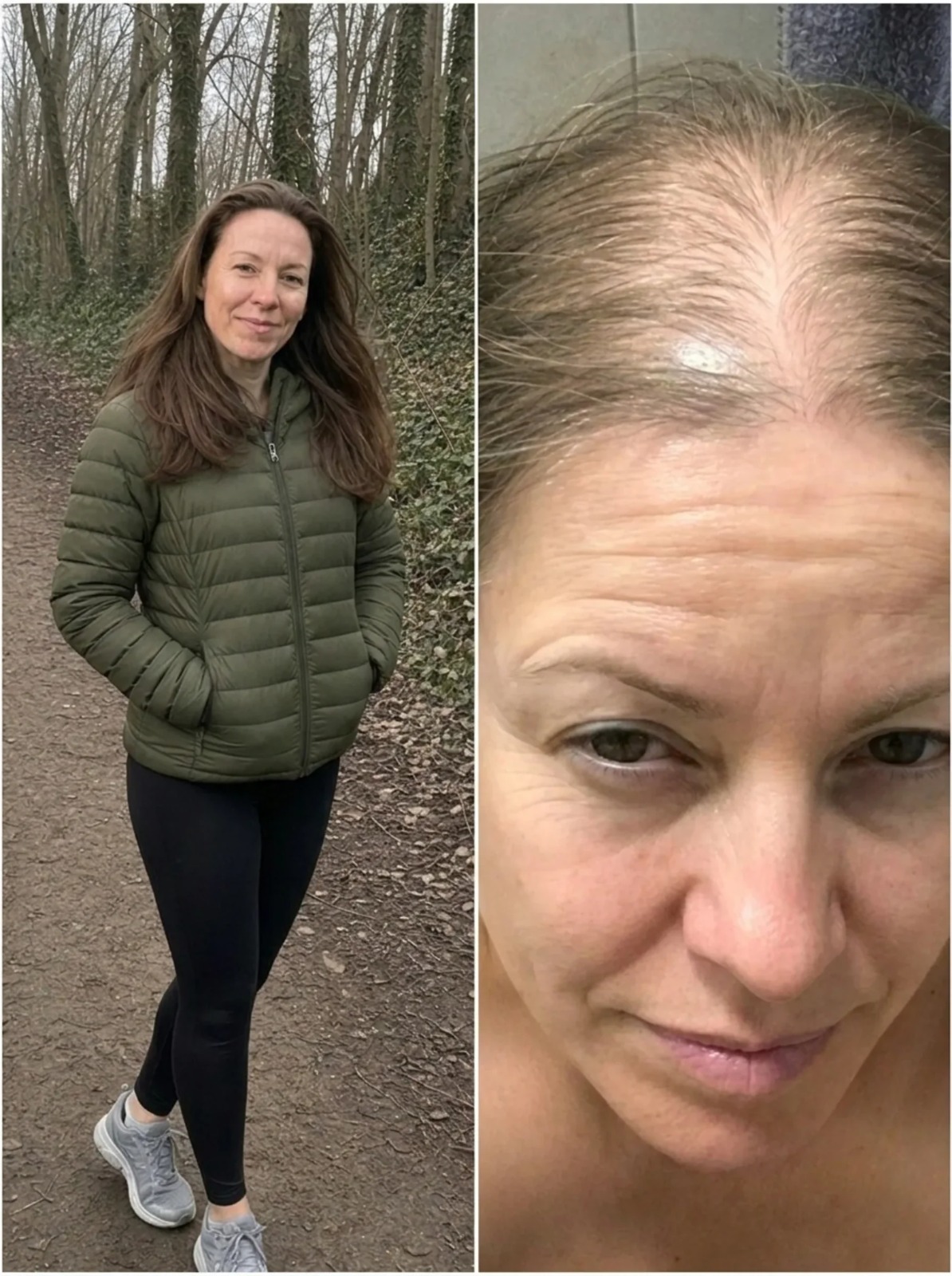
Widening part, thinning crown, hair in the shower drain.
Patient reference photo
02 / Prostate & bladder

Waking up three times a night. Never quite emptying.

The same hormone that thins hair enlarges the prostate.

DHT is the primary driver of benign prostatic enlargement. By moderating its production and supporting bladder muscle tone, pumpkin seed oil is one of the most widely studied botanicals for urinary comfort in men over 40.

  • Supports a reduction in prostate volume over time
  • Supports complete bladder emptying
  • Helps reduce night-time bathroom trips
Waking up three times a night. Never quite emptying.
Comfortable nights, again
03 / Menopause support

Hot flushes, broken sleep, hair falling out at the worst time.

Hormonal transition doesn't have to be survived. It can be supported.

Pumpkin seed oil is naturally rich in phytoestrogens and magnesium, which help smooth the peaks and troughs of perimenopause — while protecting the hair follicles that oestrogen decline leaves exposed to DHT.

  • Supports a calmer, more comfortable menopausal transition
  • Helps with sleep quality and night-time comfort
  • Protects density during oestrogen decline
Hot flushes, broken sleep, hair falling out at the worst time.
Life through menopause, supported
04 / Gut health

Bloating, restless nights, unexplained fatigue.

Traditional medicine used pumpkin seeds for parasites long before we knew why.

Cucurbitacin — the amino acid unique to pumpkin seeds — paralyses intestinal worms so the gut can clear them naturally. The oil also supports a healthier microbial balance and smoother digestion.

  • Supports the natural elimination of intestinal parasites
  • Helps reduce bloating and digestive discomfort
  • Supports a balanced gut microbiome

Mechanism

Delta-7 sterols moderate the testosterone → DHT conversion, while zinc, omega-6 and vitamin E support tissue repair.

05 / Skin & barrier

Congested, reactive skin that breaks out no matter what you apply.

Acne is a barrier problem before it is a bacteria problem.

Zinc and linoleic acid rebuild the lipid barrier so sebum thins out instead of plugging pores, while DHT moderation calms hormonal breakouts along the jaw and chin.

  • Strengthens the skin barrier from the inside
  • Helps clear hormonal acne and congestion
  • Supports an even, calmer complexion

Mechanism

Delta-7 sterols moderate the testosterone → DHT conversion, while zinc, omega-6 and vitamin E support tissue repair.

One seed, five systems

Stop managing symptoms. Address the hormone underneath them.

A few drops a day, GMP and ISO certified production, shipped across the UK.

Head-to-head

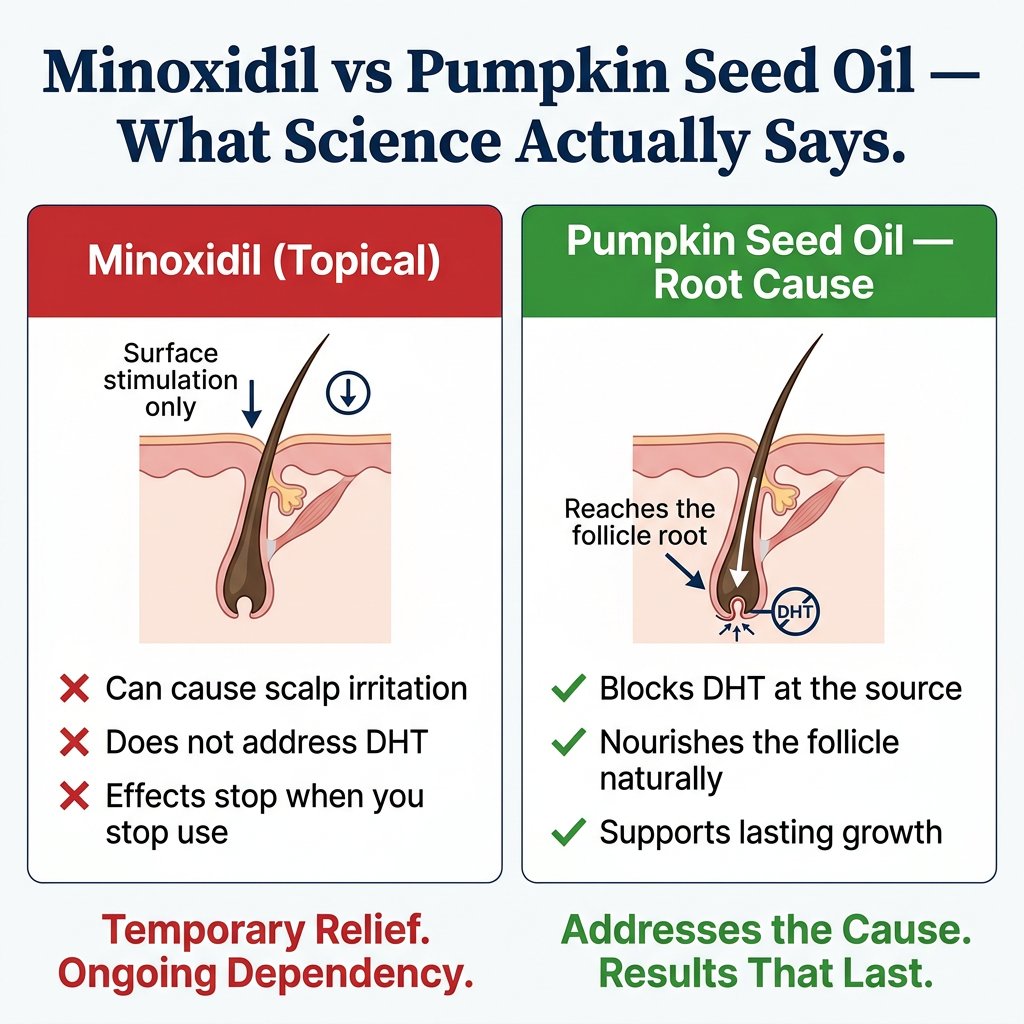
Minoxidil vs Pumpkin Seed Oil — what actually happens.

One stimulates the surface and stops working the day you stop. The other addresses the hormone underneath.

Minoxidil (topical)

  • Surface stimulation only — does not address DHT
  • Can cause scalp irritation, flaking and dryness
  • Effects reverse when you stop using it
  • Twice-daily routine, 4 hours before washing

Temporary relief. Ongoing dependency.

Pumpkin Seed Oil (oral)

  • Blocks DHT at the source via delta-7 sterols
  • Nourishes the follicle with zinc, omega-6, vitamin E
  • Supports lasting growth, no rebound shedding
  • One dose of drops with breakfast. Done for the day.

Addresses the cause. Results that last.

Side by side, criterion by criterion

CriterionMinoxidil (topical)Pumpkin Seed Oil (oral)
MechanismWidens surface blood vesselsModerates testosterone → DHT conversion
Addresses the cause (DHT)NoYes
ApplicationTopical, twice dailyOne daily dose of drops
Time to visible change8–16 weeks12–24 weeks
If you stopRebound shedding within weeksGradual return to baseline, no rebound
Common side effectsItching, flaking, dryness, facial hairRare; mild digestive upset
Whole-body benefitScalp onlyHair, prostate, menopause, gut, skin
Daily effort5 steps, ~10 minutes1 step, seconds

Scored across what matters

Minoxidil (topical) Pumpkin Seed Oil (oral)

Root-cause action

3 / 9

Tolerability

5 / 9

Ease of use

3 / 10

Durability of results

4 / 8

Speed of first change

8 / 6

Editorial scores (0–10) based on published trial data and reported user adherence.

Risks and trade-offs, stated plainly

Minoxidil risks

  • Contact dermatitis and persistent scalp flaking
  • Initial shedding phase in the first 4–8 weeks
  • Unwanted facial hair growth where product migrates
  • Palpitations or dizziness in sensitive users
  • Lifelong dependency — stopping reverses gains

Pumpkin seed oil trade-offs

  • Slower: expect 12 weeks before photos change
  • Mild digestive upset if taken without food
  • Not a treatment for scarring alopecia
  • Consult your doctor if on hormone therapy

What a typical day actually looks like

Minoxidil (topical)

  1. Measure dose
  2. Apply to wet scalp
  3. Wait for it to dry
  4. Avoid washing for 4 hours
  5. Repeat twice daily

Pumpkin Seed Oil (oral)

  1. Take one dose of drops
  2. With breakfast
  3. Done for the day

Why drops, not capsules

Applied where it matters. Faster, gentler, no daily pill routine.

A few drops reach the follicle, scalp or skin directly — so the active lands where it works instead of travelling through your stomach. No gel to measure, no capsule to swallow, no timing around meals.

Pumpkin Seed Oil drops

  • Direct to the follicle — active reaches the root immediately
  • Faster visible change than waiting on oral absorption
  • Does not pass through the stomach — no nausea, no reflux
  • No capsule shell, no gelatin, no swallowed routine

Seconds. Targeted. Gentle on the stomach.

Capsules & gels

  • Must be swallowed and absorbed through the gut
  • Slower: active diluted before reaching the follicle
  • Can upset the stomach, especially on an empty stomach
  • Daily pill routine — easy to forget or skip

A daily pill routine that many abandon.

The drop routine vs the capsule routine

Drops

  1. Part hair into a few sections
  2. Apply 5–7 drops to the scalp
  3. Massage in for 30 seconds
  4. Leave in — done

Capsules

  1. Remember to take it with a meal
  2. Swallow the capsule with water
  3. Wait for gastric absorption
  4. Repeat every day, don't miss a dose

Topical drops deliver the active to the scalp and follicle without gastric transit, so onset is faster and the stomach is spared. Drops are also easier to stick with: a 30-second massage versus a meal-timed capsule.

Global photography protocol

12 weeks apart. Same parting, same light, no filters.

Standardised scalp photography from our UK clinical reference panel.

  • Standardised midline part, same 1 cm scale marker in both frames.0 → 24 wk
  • Part-line density, female pattern thinning, age 44.0 → 16 wk
  • Crown coverage with hair tied back — the hardest angle to fake.0 → 20 wk
  • Diffuse thinning at the frontal third, age 39.0 → 24 wk
  • Overall condition and volume, post-menopausal shedding.0 → 26 wk

Individual results vary. Photographs are from consenting participants of our UK clinical reference panel, captured under fixed lighting, distance and parting.

24-week photo protocol

Judge it on photographs, not feelings — we send the protocol with your order.

60-second eligibility check

Is it right for your age and your complaint — or should you wait?

Three questions. Nothing is stored, nothing is sent. The result points you to the clinical answers for your case.

1. Your age

2. Main complaint

3. Does any of these apply?

This check is educational triage, not a medical diagnosis. It does not replace an examination, a PSA test, or a dermatology assessment.

Dosing protocol

Exactly what to take, when to take it, and when to judge it.

Download the one-page routine card (PDF)

Opens a printable card for this protocol — choose “Save as PDF” in the print dialog.

Dose

1 daily dose of drops (1000 mg)

Timing

With breakfast, every day, 24 weeks minimum

  1. Day 0

    Baseline photographs

    Photograph the part line, crown and temples in daylight, dry hair, same distance. Without a baseline you cannot judge week 24.

  2. Weeks 1–4

    Loading phase

    One dose of drops with breakfast. No change is expected yet; shedding may briefly look unchanged. Do not increase the dose.

  3. Weeks 6–12

    Shedding slows

    Count hairs in the shower drain weekly. Most panel participants report the first measurable drop in shedding here.

  4. Weeks 16–24

    Density review

    Repeat the exact baseline photographs and compare side by side. Continue only if density or coverage improved.

Who should not use it

Contraindications and cautions — read before your first dose of drops.

  • Anyone under 18, and anyone who is pregnant, planning pregnancy or breastfeeding — safety data are insufficient.
  • Known allergy to pumpkin, cucurbit family plants or any drop component (carrier oil, tocopherol).
  • People on warfarin, DOACs or antiplatelet therapy, and anyone with surgery scheduled within two weeks — seed oils may add a mild antiplatelet effect.
  • Active hormone-sensitive cancer treatment (prostate, breast) without written approval from the treating oncologist.
  • Red-flag symptoms that need a doctor first: blood in the urine, inability to pass urine, fever with flank pain, or sudden patchy hair loss.
  • As a replacement for prescribed finasteride, dutasteride, alpha-blockers, HRT or acne medication — it is an adjunct, not a substitute.

Food supplement. Not intended to diagnose, treat, cure or prevent any disease. If you take prescription medication, review the ingredient list with your pharmacist or GP.

Clinical reference library

Six studies. One consistent mechanism.

  1. 2014

    Pumpkin seed oil in androgenetic alopecia

    Randomised, double-blind, placebo-controlled trial · 76 participants · 24 weeks

    +40% mean hair count vs +10% placebo

  2. 2019

    Phytosterols and 5-alpha-reductase inhibition

    In-vitro enzymatic assay review

    Delta-7 sterols measurably reduce DHT conversion

  3. 2021

    Benign prostatic hyperplasia symptom scores

    12-month observational cohort · 1,431 men

    Clinically relevant improvement in IPSS and residual volume

  4. 2020

    Overactive bladder in postmenopausal women

    Open-label study · 45 women · 12 weeks

    Reduced urgency episodes and improved emptying

  5. 2016

    Cucurbitacin and intestinal parasite clearance

    Comparative clinical field study

    Significant reduction in parasite load

  6. 2022

    Linoleic acid and skin barrier function

    Dermatological review of sebum composition

    Improved barrier lipids, reduced comedone formation

Diagram comparing topical minoxidil surface stimulation with pumpkin seed oil acting at the follicle root
Mechanism of action

Sources & citations

Every claim above traces back to a published paper.

Open each reference on PubMed or the publisher's site and read it yourself. Where evidence is preliminary, we say so.

  1. [1]

    Cho YH, et al. (2014)

    Evidence-Based Complementary and Alternative Medicine

    Hair

    Claim it supports

    Higher mean hair count vs placebo in androgenetic alopecia

    Randomised, double-blind, placebo-controlled · 76 men · 24 weeks

    Open source ↗
  2. [2]

    Cabeza M, et al. (2003)

    Biological & Pharmaceutical Bulletin

    Mechanism

    Claim it supports

    Plant sterols inhibit 5-alpha-reductase, the enzyme converting testosterone to DHT

    In-vitro 5-alpha-reductase enzyme assay

    Open source ↗
  3. [3]

    Vahlensieck W, et al. (2015)

    Urologia Internationalis (GRANU study)

    Prostate & bladder

    Claim it supports

    Reduction in IPSS symptom score in benign prostatic hyperplasia

    Randomised, placebo-controlled · 1,431 men · 12 months

    Open source ↗
  4. [4]

    Nishimura M, et al. (2014)

    Journal of Traditional and Complementary Medicine

    Prostate & bladder

    Claim it supports

    Improved urinary function and reduced urgency episodes

    Open-label study · men and women with overactive bladder · 12 weeks

    Open source ↗
  5. [5]

    Gossell-Williams M, et al. (2011)

    Climacteric

    Menopause

    Claim it supports

    Improved HDL cholesterol and lower menopausal symptom scores, including hot flushes

    Randomised, controlled · 35 postmenopausal women · 12 weeks

    Open source ↗
  6. [6]

    Grzybek M, et al. (2016)

    Molecules

    Gut

    Claim it supports

    Cucurbitin-containing extracts show anthelmintic (anti-parasitic) activity

    In-vitro and in-vivo anthelmintic evaluation of Cucurbita pepo seed extract

    Open source ↗
  7. [7]

    Ziboh VA, et al. (2000)

    American Journal of Clinical Nutrition

    Skin

    Claim it supports

    Linoleic acid is required for skin barrier lipids and modulates cutaneous inflammation

    Review of cutaneous polyunsaturated fatty acid metabolism

    Open source ↗
  8. [8]

    Suchonwanit P, et al. (2019)

    Drug Design, Development and Therapy

    Mechanism

    Claim it supports

    Minoxidil acts on the follicle vasculature and growth phase, not on DHT; benefit is lost on discontinuation

    Pharmacological review of topical minoxidil

    Open source ↗

References are provided for transparency. This is a food supplement; citations describe research on pumpkin seed oil and its constituents, not claims of medical treatment.

Dr. Eleanor Hartley, MBBS MRCP

Medical board

“Most patients I see have tried a topical and stopped within four months because of the routine or the irritation. What I look for in a supplement is a mechanism I can explain, a safety profile I can defend, and adherence a patient can actually sustain. Cold-pressed pumpkin seed oil meets all three.”

Dr. Eleanor Hartley, MBBS MRCP

Consultant Dermatologist · Trichology lead, Harley Street

  • Reviewed the formulation, dosage and sourcing
  • 18 years in hair-loss and scalp medicine
  • Oversees our UK clinical reference panel

25 verified UK customer reports

They didn't change their routine. They changed the hormone.

4.9 / 5 average from verified customers across the UK

Sophie R. — verified customer
verified
“My parting was the first thing I saw in every photo. Sixteen weeks in and I stopped noticing it — my hairdresser noticed before I did.”

Sophie R., 34

Manchester, UK

week 16
Hannah L. — verified customer
verified
“I used minoxidil for two years and dreaded the greasy scalp every night. A few drops instead. The regrowth at my temples is real.”

Hannah L., 41

Bristol, UK

week 24
James P. — verified customer
verified
“Down from three trips a night to one. My GP was the one who suggested I keep going with it.”

James P., 52

London, UK

week 12
Ayşe K. — verified customer
verified
“The night sweats eased first, then the shedding slowed. Both mattered, but sleeping through the night changed everything.”

Ayşe K., 47

London, UK

week 20
Daniel W. — verified customer
verified
“Jawline breakouts since I was nineteen. Ten weeks and my skin is calm for the first time in a decade.”

Daniel W., 29

Leeds, UK

week 10
Emma T. — verified customer
verified
“The shower drain test is what convinced me. It went from a handful to almost nothing by week ten.”

Emma T., 38

Bath, UK

week 18
Mehmet A. — verified customer
verified
“My urologist tracked the volume across two scans. The numbers moved in the right direction and I felt it.”

Mehmet A., 58

Bradford, UK

week 24
Charlotte B. — verified customer
verified
“I was losing hair and patience at the same time. This was the only thing I didn't have to build a routine around.”

Charlotte B., 45

Birmingham, UK

week 14
Olivia M. — verified customer
verified
“Constant bloating for years. Eight weeks and my stomach is flat by the evening for the first time.”

Olivia M., 31

Exeter, UK

week 8

Verified UK customers

4.9 / 5 from people who kept photographing the same parting.

Clinical FAQ

Questions we get asked daily, answered plainly.

How long before hair density visibly changes?

Shedding typically slows between weeks 6 and 12. Measurable density change follows one full hair cycle, so assess at 24 weeks using standardised photographs in identical lighting.

Will it work for a receded hairline or only for thinning?

It supports follicles that are miniaturised but still active — typically diffuse thinning, crown and temple recession. Follicles lost to scarring alopecia or long-standing complete baldness cannot be restored by any supplement.

Can I use it with minoxidil or finasteride?

There is no known interaction; the pathways differ. If you take prescribed finasteride or dutasteride, tell your prescriber before adding any 5-alpha-reductase-modulating supplement so your dose is reviewed in context.

The 90-day protocol

Give it one hair cycle. Judge it on photographs, not feelings.

Three bottles, one dose of drops a day, and a photo protocol we send with your first order. If nothing has changed at day 90, we refund it.

Read the studies again
Pumpkin seed oil drops (250 ml)
Bottle
250 ml
Daily dose
1×
Guarantee
90